The transition toward cleaner energy and transport systems requires not only new fuels, but also reliable emission control technologies. As the use of bio-based, renewable, and waste-derived fuels increases, it is important to understand how fuel-related impurities may affect catalyst performance and long-term durability.
The thesis was supervised by D.Sc. Mika Huuhtanen and D.Sc. Teuvo Maunula and carried out as part of the Flexible Clean Propulsion Technologies (Flex-CPT) project co-funded by Business Finland.
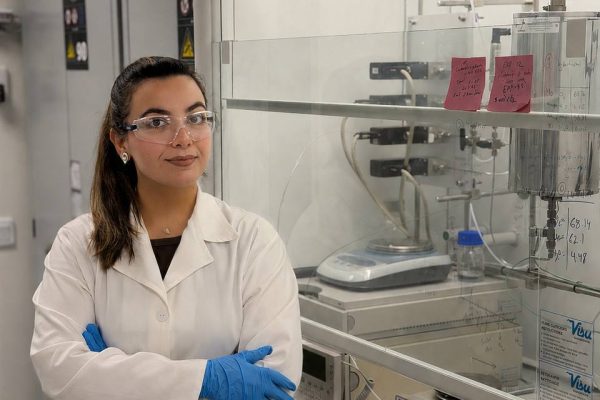
Tytti Ristikaarto recently completed her Master’s degree in Environmental Engineering at the University of Oulu. Her academic interests are strongly connected to catalysis, particularly emission catalysis and technologies that help reduce harmful emissions from industrial processes and transportation. She is also interested in circular economy solutions and the utilization of waste materials as valuable resources.
“I am motivated by the opportunity to contribute to a cleaner and more sustainable future,” Tytti says.
The thesis focused on Fe-SCR catalysts supported on Beta zeolite and examined the effects of sulphur, sodium, potassium, calcium, and phosphorus on catalyst activity and structural stability. Catalyst activity was evaluated through NOX, NH3, and N2O conversion measurements, while structural changes were analysed using several characterization methods.
The work connects closely to Flex-CPT WP4 activities by investigating, at laboratory scale, how impurities affect catalyst performance. Some of the results will also be used to validate models developed by Flex-CPT project partners.
For Tytti, one of the most rewarding aspects of the project was combining different analytical methods to build a complete picture of what happens inside the catalyst during deactivation.
“I also enjoyed working on a topic that has a clear environmental relevance. Knowing that the research contributes to cleaner technologies and reduced emissions made the work particularly meaningful,” Tytti says.
Like many experimental research projects, the thesis also included unexpected challenges. The activity measurement system used in the work was already relatively old and occasionally required troubleshooting. Sometimes experiments did not proceed exactly as planned, which required additional time to identify the source of the problem.
One memorable challenge involved gas that had degraded during storage and no longer contained the composition it was supposed to have. Although frustrating at the time, the experience later became one of those research stories that can be looked back on with humour. Such moments taught Tytti patience, problem-solving skills, and the importance of carefully verifying experimental conditions.
Looking ahead, the results improve understanding of how renewable fuel-derived impurities affect emission control catalysts and which impurities are particularly harmful to catalyst performance. This knowledge can support the development of more durable catalyst materials and improve the long-term reliability of exhaust after-treatment systems as renewable fuels become more widely used.
The work also marks the beginning of Tytti’s continued research career. After completing her Master’s degree, she started doctoral studies within the same field, where she will continue investigating emission catalysts and catalyst deactivation phenomena. Through this work, she aims to contribute to the development of cleaner and more sustainable emission control technologies.