Promising results from technology assessments do not necessarily translate into feasible implementation. Examining decarbonisation pathways in short-sea shipping, off-road mobile machinery and decentralised agricultural fuel systems, a doctoral dissertation at Åbo Akademi University investigates how energy supply conditions, infrastructure utilisation, operational constraints and policy frameworks shape the environmental performance and economic feasibility of alternative propulsion technologies.
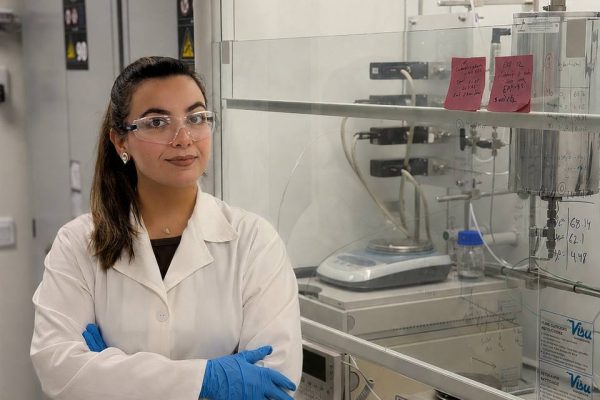
This challenge forms the basis of the doctoral dissertation of Anthony Katumwesigye, an energy-environmental engineer and doctoral researcher in Industrial Management at Åbo Akademi University. The research was conducted under the supervision of Professor Magnus Hellström, with Mr Jonas Spohr as co-supervisor.
Anthony’s academic background spans mechanical engineering, power plant engineering and sustainability science. He holds a master’s degree in sustainability science from LUT University and a master’s degree in power plant engineering from Peter the Great St. Petersburg Polytechnic University, in addition to his background in mechanical engineering.
His research was motivated by a fundamental question: why do promising clean-energy technologies often struggle to become economically viable in real-world applications? Through his doctoral research, Anthony sought to understand the conditions under which these technologies could genuinely replace fossil fuels, particularly in industries where decarbonisation remains challenging. He views this challenge through the concept of entropy: philosophically, the distance between a desired goal and the gap that must be bridged to achieve it.
The dissertation examines how alternative propulsion technologies can support the decarbonisation of maritime transport, agricultural machinery and other non-road mobile machinery. By combining life-cycle assessment (LCA) and techno-economic assessment (TEA), the research investigates not only which technologies can reduce emissions, but also whether they are economically feasible under realistic operating conditions.
The research addresses the gap between analytical comparisons and practical implementation. Instead of treating energy supply, infrastructure utilisation, operational constraints and policy frameworks as separate considerations, the dissertation incorporates them directly into the assessment of each technological pathway.
Bringing together four research papers, the dissertation compares technologies with different operating characteristics, energy requirements and levels of technological maturity. This presented a major methodological challenge. Anthony addressed it by establishing consistent functional units, defining transparent system boundaries and applying scenario-based environmental and economic assessments. These measures provided a consistent basis for comparing different technologies across the sectors studied.
The analysis shows that the relative performance of alternative technologies depends on the context in which they are assessed and expected to operate. As Anthony explains, “One of the most important findings is that there is no universally optimal decarbonisation technology. Performance depends on the application, energy source, infrastructure utilisation, and economic conditions.”
In short-sea shipping, the scope of the life-cycle assessment, methane slip, electricity sourcing and policy rules all affect the comparison between alternative propulsion options.
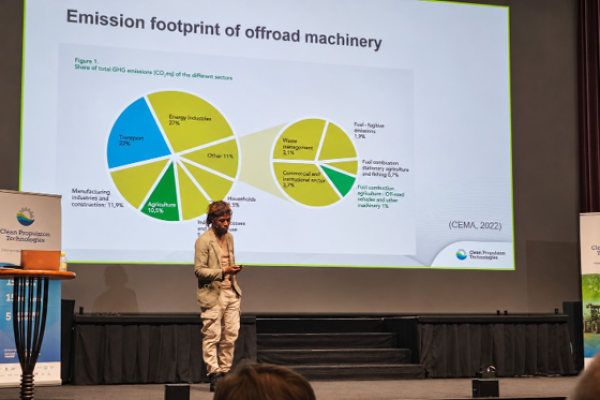
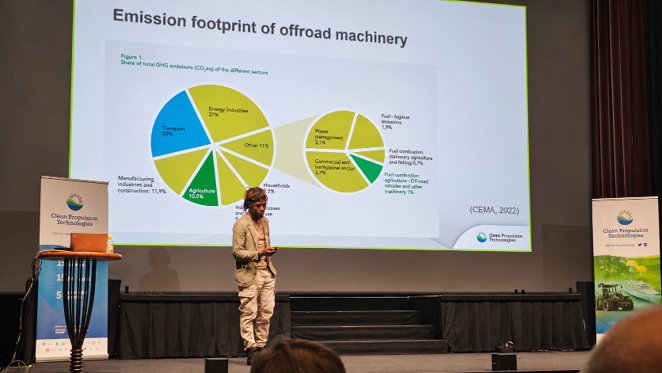
For off-road machinery, environmental and economic performance depends on both the service provided by the machinery and the utilisation of supporting infrastructure. Battery-electric wheel loaders, for example, can deliver substantial emissions reductions and become economically competitive under favourable Nordic operating conditions. Hydrogen alternatives face higher costs, particularly where the infrastructure required to support them is underutilised.
In decentralised hydrogen systems, electricity prices and capacity factor are the principal influences on cost and feasibility, while low utilisation further limits viability.
A central conclusion of the dissertation is that technological potential alone is insufficient to support implementation. Energy supply, infrastructure, operational requirements and policy conditions must align before a technological pathway can become practically feasible.
To bring these conditions together, Anthony developed an adoption-gates framework covering energy supply, infrastructure availability and utilisation, policy and accounting rules, and compatibility with operational requirements. By connecting these conditions with the assumptions applied in environmental and economic assessments, the framework helps explain why a technology that performs well in a narrowly defined study may nevertheless be difficult to implement in practice.
The dissertation also acknowledges that its conclusions depend on assumptions concerning energy prices, electricity supply, infrastructure utilisation and future technological developments. They should therefore be understood as evidence for decision-making under defined conditions rather than as universal predictions.
The doctoral research supports the objectives of the Flexible Clean Propulsion Technologies (Flex-CPT) project by providing environmental and techno-economic evidence for evaluating alternative propulsion and fuel technologies. Its contribution is particularly relevant to life-cycle emissions assessment, energy-consumption analysis and the comparative evaluation of low-carbon propulsion pathways.
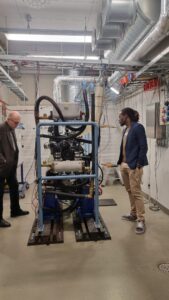
The research also benefited from collaboration with the University of Agder in Norway, particularly in the assessment of alternative propulsion systems for non-road mobile machinery.
Looking back, Anthony describes his doctoral journey as intellectually demanding, rewarding and transformative. It taught him persistence, scientific discipline and the value of interdisciplinary collaboration. One of the most important lessons was learning to challenge assumptions rather than simply accept promising technological results. Reflecting on this lesson, he explains: “For me, good research is not only about finding answers, but also about asking the questions that make those answers meaningful in practice.”
The doctoral journey also reinforced Anthony’s interest in connecting engineering, environmental sustainability and energy economics. “Above all, I have learned that successful decarbonisation requires more than technological innovation; it requires an understanding of the economic, infrastructural, and institutional conditions that enable implementation.”
Building on this experience, Anthony now aims to extend his research towards practical industrial applications, particularly by developing integrated assessment and decision-support tools for sustainable energy investments.