Lithium-ion batteries have become an important part of modern energy systems, supporting the shift towards cleaner technologies and more sustainable energy storage. However, as their use continues to grow, ensuring their safety and performance remains a key challenge. One particular concern is heat generated during battery operation, which can affect performance and, in extreme cases, lead to thermal runaway. This has increased interest in effective thermal management solutions, including phase change materials that absorb heat during phase change.
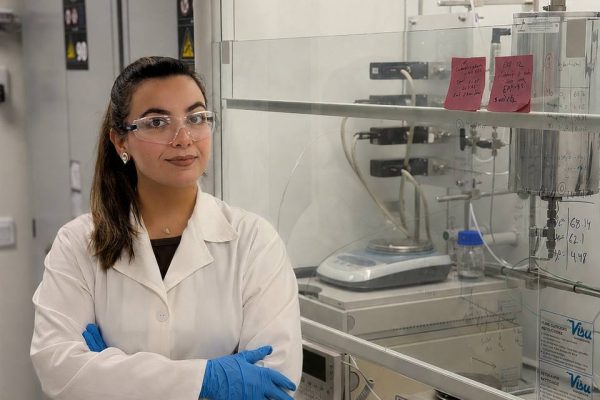
This challenge forms the basis of the Master’s thesis of Ellinoora Veikkanen at LUT University, where she investigates the use of phase change materials (PCMs) for managing temperatures in Li-ion battery modules. The thesis was completed as part of the Master’s Programme in Sustainable Energy Systems at LUT University and examined by Professor Jouni Ritvanen and Professor Pertti Kauranen.
Phase change materials have attracted interest in battery thermal management because of their relatively low costs and simple operation. Their working principle is based on latent heat, the energy absorbed when a material changes phase. This allows the material to absorb heat generated by the battery and delay the temperature rise.
At the core of her thesis lies a practical question: how can phase change materials help control the temperature rise of Li-ion battery modules? To address this, Ellinoora combined an examination of Li-ion battery characteristics and thermal management principles with the development of a three-dimensional computational fluid dynamics (CFD) model of a battery module consisting of 12 cylindrical Li-ion cells. The study focused on a phase change material known as Rubitherm RT35HC, examining how it affects temperature development and how natural convection influences the melting process.
Developing the CFD model also presented challenges, particularly the long computational time required to run the simulations. To address this, Ellinoora simplified the model, reducing the computational time and making the simulations more manageable while allowing her to investigate the key aspects of the material’s thermal behaviour.
The research revealed that, while the PCM significantly delayed the temperature rise of the battery module, natural convection had a considerable influence on the melting process. It accelerated melting in the upper part of the module but also caused non-uniform melting, resulting in temperature differences that exceeded the 5°C limit. The CFD modelling also showed that the studied phase change material had a limited ability to absorb heat from the battery surface.
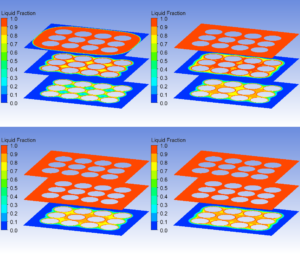
Together, these findings underline the importance of considering both heat absorption and temperature uniformity when designing PCM-based thermal management systems. They also highlight the importance of optimizing the material’s thermal conductivity and the amount of PCM used to improve its effectiveness.
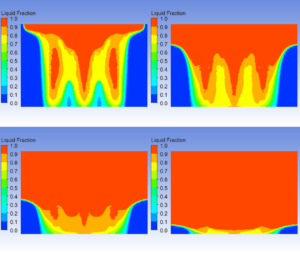
Ellinoora notes that the simplifications made in the CFD model should be considered when interpreting the results. Looking ahead, further research could examine the effects of PCM thermal conductivity and cyclic heat generation in greater detail, helping to develop and refine more effective battery thermal management solutions.
The thesis was conducted as part of Work Package 5 (WP5) of the Flexible Clean Propulsion Technologies (Flex-CPT) project, which explores pathways towards cleaner propulsion and energy systems. By investigating how phase change materials influence battery temperatures, the thesis contributes to the development of knowledge relevant to safer and more effective battery systems.
For Ellinoora, the thesis brought together her interests in sustainable energy solutions, energy storage and CFD modelling. Working on it has deepened her understanding of Li-ion batteries, phase change materials and numerical modelling, providing valuable knowledge and experience that she can build on in her future work. Now that the thesis is complete, she hopes to continue pursuing her interest in sustainable energy solutions and contribute to the development of technologies that support a cleaner future.