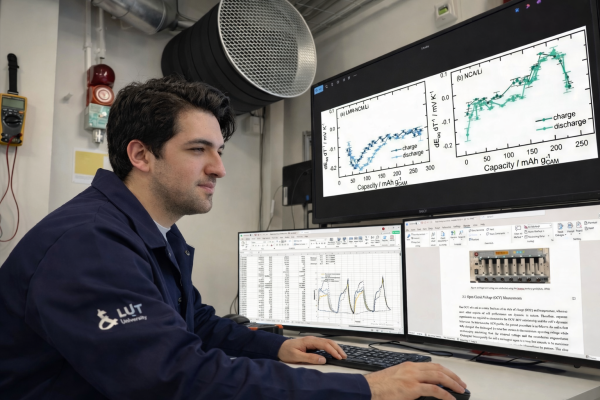
Some research visits are about stepping outside everyday routines. Others are about stepping straight into the heart of a problem. When Rasmus Pettinen travelled from Finland to southern Sweden, he did so in a dual role, both as a visiting researcher at Lund University and as the WP2 (High-Speed Engines) Leader of the Flexible Clean Propulsion Technologies (Flex-CPT) project. In practice, these roles pointed in the same direction, making methanol work in real off-road engines operating under demanding Nordic conditions.
Main library of Lund University
Pettinen’s work within Flex-CPT focuses on spark-ignition engine concepts and their readiness for sustainable fuels. Methanol is a highly attractive option due to its unique properties and its potential to reduce the well-to-wheels carbon footprint of the off-road industry. At the same time, implementation of neat methanol introduces a few well-known challenges. In particular, the fuel does not typically evaporate efficiently during cold starts and transient operation, which makes reliable all-season use difficult, especially in Nordic environments.
The purpose of the mobility was therefore clear. The goal was to study and address these evaporation-related challenges and to identify viable methods for improving methanol evaporation in spark-ignition engine concepts. This topic is directly connected to WP2, where high-speed engines and SI concepts are studied from multiple perspectives. The Division of Combustion Engines at Lund, widely recognised for its extensive work on methanol fuels, offered an excellent environment to support this effort.
The research itself focused primarily on numerical investigations. Dedicated 0D/1D simulation tools were used to address known evaporation issues at the engine level. As the work progressed, limitations in the existing toolsets became apparent, mainly due to missing calibration data for the specific use case. Because of this, the work could not be fully carried out within the available tools.
Instead, parts of the study were extended beyond standard frameworks. Traditional numerical solvers were combined with 0D/1D simulation data, using simplified methodologies resembling those commonly applied in spray physics. This allowed the work to continue while keeping the focus on the underlying physical phenomena rather than on software constraints.
The outcomes were directly relevant for Flex-CPT project. The work made it possible to identify the most important factors influencing methanol evaporation and to map the parameters that should be prioritised in the project’s real-world demonstrator. As Pettinen summarises “The key results enabled us to identify the most important factors for improving methanol evaporation and to map the parameters we should focus on for our real-world demonstrator.”
This supports significant progress in screening suitable injection-related settings and in commissioning methanol as a fuel for an NRMM engine operating in Nordic conditions. Overall, the work provided both practical and theoretical guidance for future methanol-based off-road engine development.
The mobility also offered valuable professional development. With a background that has strongly emphasised experimental research, Pettinen gained new insights into computational principles related to numerical modelling and engine simulations. The exchange provided an opportunity to explore in detail how engine hardware, fuel injection as a phenomenon, and physical principles are connected. What stayed with him most was not just the technical progress, but the people behind it. Pettinen describes it simply “For me, collaboration and networking are naturally the most fun and important parts of a trip like this. The biggest value comes from having the privilege to visit a very qualified research group, gaining valuable inputs and being able to expand your knowledge in leaps not possible in an everyday surrounding.”
Challenges were part of the process. Partway through the mobility, it became clear that one of the main programs used was not fully compatible with the intended research tasks. Significant gaps were identified between the built-in models and real-world physics, which could not be resolved without dedicated experimental data. As a result, parts of the computation were carried out using more traditional numerical modelling approaches based on established spray physics methodologies.
Outside the research work, the experience in Sweden was equally positive. The research group in Lund provided a warm welcome, and time was spent together both during and outside working hours. Southern Sweden also offered good fishing opportunities, and many evenings and weekends were spent by the waters of Skåne. Living in Sweden felt familiar, with many similarities to Finland. Lund’s compact size, good services, and well-functioning public transport made daily life easy. Having roots in southern Sweden also provided a natural opportunity to visit relatives during the stay.

Following the exchange, the next steps will take place back in Finland. Experimental validation will begin using VTT’s dedicated methanol research engine, and the numerical model developed during the mobility will be calibrated using experimental data. The combination of numerical and experimental work is expected to result in scientific publications.
From a WP2 leadership perspective, the mobility supported the project by extending knowledge on how to overcome evaporation-related challenges and how to accelerate the commissioning of methanol internal combustion engines for off-road applications. Maximising fuel evaporation is particularly important under Nordic conditions, where engines can be difficult to start. Improved evaporation also helps prevent the formation of harmful exhaust emissions in cold climates and reduces premature engine wear.
The results of the exchange complement parallel work within the Flex-CPT consortium. While colleagues at Aalto University focus on detailed 3D CFD studies of methanol evaporation in the intake and in-cylinder, VTT addresses the topic at the engine level using 0D/1D approaches under broader environmental conditions. Together, these activities support progress in understanding and improving methanol evaporation.
Looking ahead, the mobility also highlighted clear opportunities for continued collaboration. Early in the exchange, it became apparent that the same research questions are actively studied at universities, where similar work has been ongoing for several years and continues today. Given that sustainable and climate-neutral fuels are widely seen as the only viable path forward for future internal combustion engines, further collaboration seems not only possible, but likely.