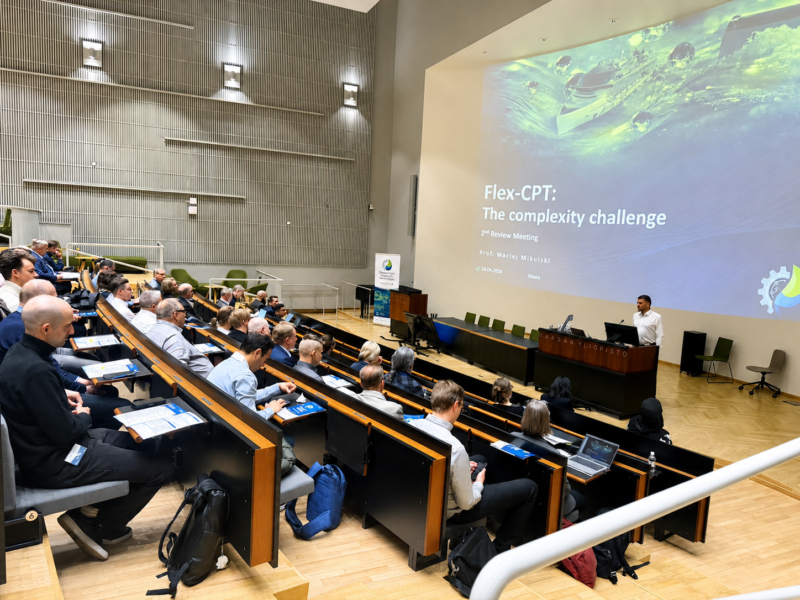
The Flexible Clean Propulsion Technologies (Flex-CPT) project reached another important milestone with the successful 2nd Review Meeting, held at the University of Vaasa on 22–23 April 2026. bringing together over 80 representatives from industry, academia, and research organizations, creating a structured platform for reviewing progress, aligning future objectives, and deepening collaboration around the shared challenge of developing fuel-flexible propulsion systems.
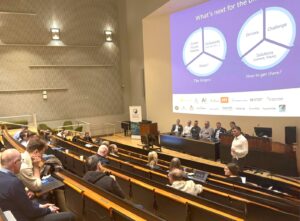
The meeting was opened by Prof. Maciej Mikulski (University of Vaasa), Project Leader, who welcomed participants and set the stage for two days of insightful discussions. In his opening, he emphasized that Flex-CPT is fundamentally addressing the “immense complexity problem of a fuel-diversified future”, highlighting “that no single fuel or technology pathway can solve all sustainability challenges”. Instead, the project aims to build a critical mass of competence, resources, and enabling solutions capable of supporting multiple energy carriers and application domains.
He further underlined that the objective is not only technological progress, but also the alignment of research and development efforts across sectors to enable fuel- and platform-agnostic solutions, reflecting the increasing complexity of future powertrain systems.
The first plenary session provided a strong industry-grounded perspective. Timo Kokko (AGCO Power) and David Köping (AGCO Finland) presented the non-road mobile machinery user landscape, offering insights into operational requirements and user-driven challenges.
This was followed by Off-Road Mobile Machinery Electrification – Challenges and Opportunities, with contributions from Jonas Hedström (LOGSET) representing the machine manufacturer perspective, and Arno Amberla (Proventia) representing the system supplier perspective. Their combined contributions highlighted both technological opportunities and system-level constraints in electrification pathways.
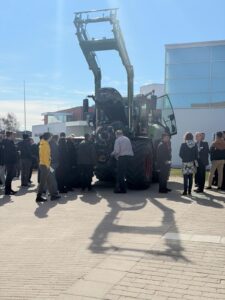
The session was complemented by a live AGCO tractor showcase, directly linking technical discussions to real machinery and reinforcing the importance of grounding research in practical applications.
The second plenary session brought valuable external perspectives delivered by two keynote speakers. Prof. Martin Tunér (Lund University, Sweden) presented “Lessons from Road Vehicle Powertrains for the Future Sustainable Off-Road Applications”, emphasizing the continued role of engines as flexible and fuel-adaptable systems, and highlighting that efficiency improvements and sustainable fuel integration can deliver substantial global emission reductions .
The session continued with Kaarina Kaminen, Environmental Specialist and Researcher at the Finnish Environment Institute, who addressed Policy Measures to Promote the Decarbonisation of Non-Road Mobile Machinery. She highlighted the key systemic challenges including policy uncertainty, high investment costs, infrastructure limitations, and fragmentation across stakeholders.
The first day concluded with a panel discussion that brought together diverse perspectives from industry, academia, and policy. The exchange highlighted both the complexity of the transition and the shared commitment to addressing it collaboratively, setting a clear direction for the technical work to follow.
The second day started with a company visit to the premises of LOGSET, where participants were introduced to industrial applications and real operating environments. The programme included a guided tour of manufacturing facilities and a presentation on current powertrain developments, including hybrid system concepts for off-road equipment, highlighting practical challenges and opportunities related to efficiency improvement and emission reduction. The visit provided a valuable connection between the research carried out within Flex-CPT and its real-world industrial context.
The programme continued with dedicated technical sessions addressing the consortium’s core research areas. The first session, dedicated to Multi-Fuel Engines, addressed ongoing developments in combustion and engine concepts. Presentations covered topics such as NVO injection strategies for extending low-load RCCI operation, adaptive modelling and control approaches for combustion optimization, analysis of hydrogen engine behaviour, and progress toward heavy-duty methanol spark-ignition engine development. Together, these contributions highlighted the breadth of research efforts aimed at enabling efficient and flexible engine operation across multiple fuel types.
In parallel, the second session on Flexible Powertrains focused on system-level perspectives and performance evaluation. The discussions included comparative life-cycle and techno-economic assessments of diesel, battery-electric, and hydrogen pathways, as well as analyses of greenhouse gas performance for alternative marine fuels. Additional contributions addressed fundamental processes such as droplet behaviour in urea-water spray injection and modelling approaches for optimizing coolant flow in thermal management systems. These presentations reflected the integration of component-level understanding with broader system considerations.
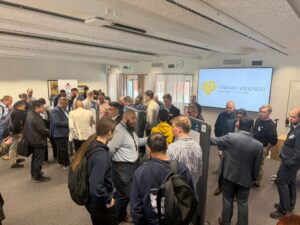
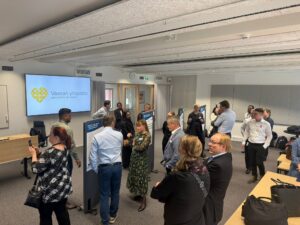
The event featured a successfully poster session, presenting the project’s achievements alongside ongoing work across the consortium. With over 20 posters presented, the session created a vibrant and highly engaging environment, sparking in-depth discussions across a wide range of topics. It provided an excellent platform for closer interaction, where ideas were explored and perspectives were shared through engaging and insightful discussions.
The meeting concluded with this session, further strengthening collaboration across the consortium and supporting knowledge exchange between different research areas.
The 2nd Review Meeting was designed to review progress while aligning the consortium on upcoming objectives and future challenges. The meeting once again highlighted the strength of the Flex-CPT consortium in advancing research and fostering collaboration between academia and industry. By combining industry insight, academic research, and policy perspectives, the project continues to build a coordinated response to the challenges of sustainable propulsion.