The transition to cleaner transport and energy systems depends not only on new fuels and powertrains, but also on the batteries that store and deliver energy. Lithium-ion cells are now central to applications ranging from electric vehicles to stationary energy storage. Yet their thermal behaviour, meaning how they heat up, cool down, and respond to operating conditions, remains a critical challenge. Temperature directly influences battery safety, performance, and lifetime, making accurate thermal understanding essential for clean propulsion technologies.
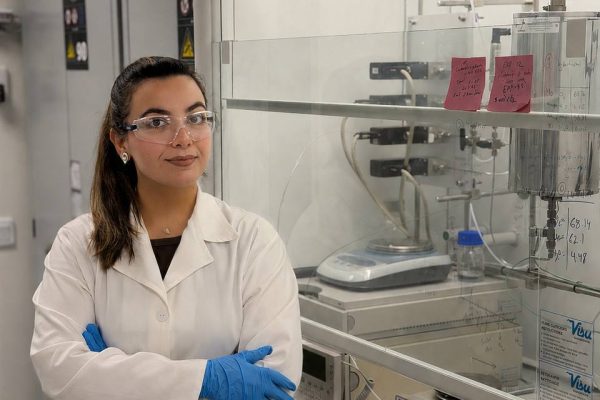
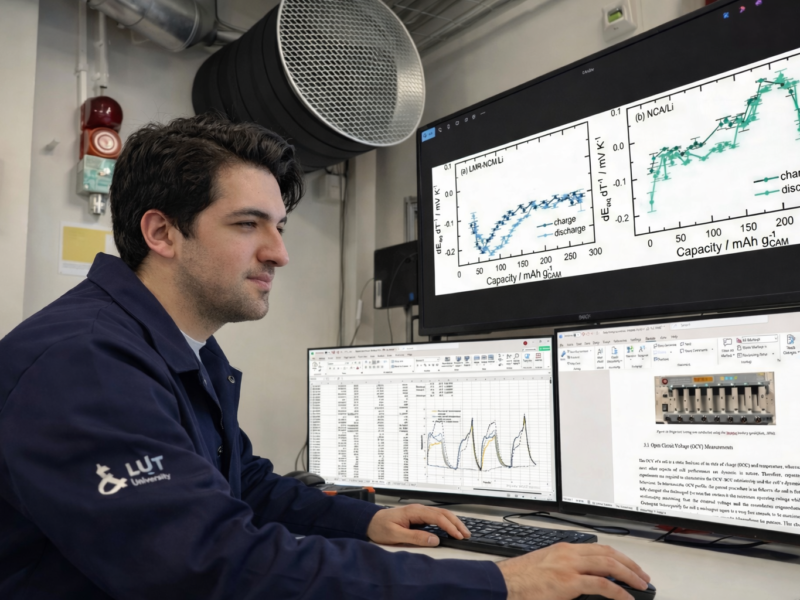
This challenge forms the background of the Master’s thesis by Soroush Mostafaie, completed in the Energy Technology programme at LUT University. In his work, Soroush investigates the thermal behaviour of a commercial 21700 NCA cylindrical lithium-ion cell by combining detailed laboratory measurements with a simplified thermal model. The thesis was supervised by Prof. Pertti Kauranen and carried out at LUT University as part of the Flexible Clean Propulsion Technologies (Flex-CPT) project .
Soroush’s academic interests lie in energy systems and battery technologies, with a particular focus on modelling and simulation, including thermal and fluid analysis. During his studies, he developed a strong interest in lithium-ion batteries due to their central role in electrification and energy storage. His thesis reflects this interest by addressing a practical and highly relevant question. How can the temperature of a lithium-ion battery cell be predicted reliably during real operation?
At a fundamental level, batteries generate heat whenever they are charged or discharged. If this heat is not properly understood or managed, it can limit performance and accelerate degradation. In his thesis, Soroush characterises the cell in detail by measuring its open-circuit voltage over different states of charge and temperatures, analysing voltage behaviour during charge and discharge, and studying the cell’s cooling behaviour after operation. These experimental results form the foundation of a lumped thermal model that aims to balance accuracy with simplicity, making it suitable for practical engineering use.
The work connects closely to Flex-CPT Work Package 5 (WP5), which focuses on thermal management challenges in hybrid and electrified propulsion systems. WP5 is led by Prof. Pasi Peltoniemi from LUT University. By analysing the thermal response of an individual battery cell, the thesis contributes to the broader Flex-CPT objective of designing safer and more efficient propulsion and energy systems.
One of the central outcomes of the research is the evaluation of how modelling assumptions affect temperature prediction accuracy. In particular, Soroush compares two different methods for constructing the open-circuit voltage curve used as model input. He validates the thermal model against experimental data at three different C-rates, namely 0.5C, 1C, and 2C, by comparing simulated and measured cell-to-ambient temperature differences. The results show that an averaging approach at constant open-circuit voltage consistently provides better agreement with experiments, even under higher thermal stress at 2C. This finding demonstrates that reliable thermal predictions can be achieved without increasing model complexity, provided that experimental input data are carefully processed.
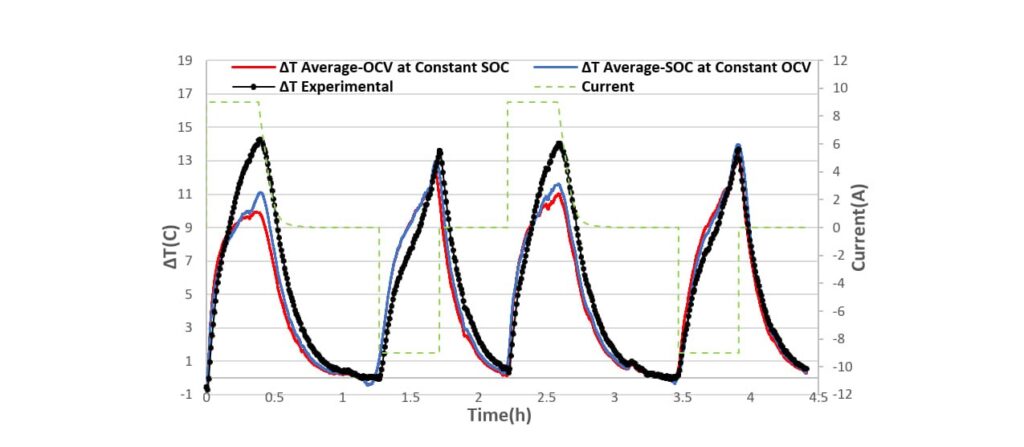
Illustration of the Simulated and Experimental Cell–Ambient Temperature Difference (ΔT) with the Applied Current Profile at 2C-Rate
Beyond temperature prediction, the thesis also examines how heat is generated inside the cell. Soroush separates different heat contributions, including irreversible losses and reversible, or entropic, effects, and studies how these vary with temperature and C-rate. He further supports the analysis with calorimetric measurements, directly comparing measured heat generation with values calculated from electrical data. This comparison provides an important additional validation step for the thermal model.
From a personal perspective, Soroush found it particularly rewarding to observe how sensitive thermal model predictions are to experimental inputs such as the open-circuit voltage curve and the entropic heat coefficient. Addressing their measurement, implementation, and associated uncertainties highlighted how even simple lumped models require careful experimental grounding to produce reliable results.
Looking ahead, the results of the thesis offer a clear and transferable framework for battery thermal analysis, starting from experimental characterisation and extending to validated modelling. In practice, this framework can support the design and assessment of battery thermal management systems and guide early-stage engineering decisions. In future research, the same approach can be extended to different battery chemistries and operating conditions, or scaled from single cells to battery modules and packs.
Now that the thesis is complete, Soroush plans to apply the skills developed during this work, including experimental testing, data analysis, and thermal modelling, to practical challenges in battery technology and energy systems. At the same time, he recognises that further refinement and validation of the developed thermal model will be necessary before it can be applied reliably across a wider range of applications.
Through its combination of structured experiments and accessible modelling, this Master’s thesis adds an important contribution to the Flex-CPT project. It shows how a detailed understanding of the thermal behaviour of a single lithium-ion cell can support the development of safer, more reliable, and more efficient clean propulsion technologies.